The Internet Security Grade Curve: What an Average Domain Looks Like in 2026
Published · updated
Figures as of 2026-08-16 · methodology v8. This is a recurring report: every edition re-measures the same population, so the curve can be tracked over time. All figures are aggregate — we never publish any individual business’s grade. See how we grade for the full method.
The average domain on the internet is not secure. Across the 377 million domains we graded, the single most common grade by a wide margin is F, and the typical domain sits at a D or below. Fewer than 1 in 12 domains reach a C or better. That is the grade curve of the internet — and it bends almost entirely toward “exposed.”
What is the average domain’s security grade?
If you lined up every graded domain on Earth and walked to the middle, you would land on a domain graded F — the lowest grade. F is not a rounding artifact or a penalty for inactivity: a domain scores F when it genuinely fails the basic protections that stop its email being forged and its visitors being misled. Most of the internet simply has those protections switched off.
Here is the full distribution.
The internet’s grade distribution (377M domains)
| Grade | Domains | Share | What it means |
|---|---|---|---|
| A+ | 72,216 | 0.0% | Effectively bulletproof — passes nearly every check |
| A | 477,419 | 0.1% | Strong: email locked down, modern TLS, key DNS protections on |
| B | 5,821,013 | 1.5% | Good, with minor gaps |
| C | 23,936,186 | 6.4% | Mixed — some real protection, some real holes |
| D | 51,464,103 | 13.7% | Weak — most protections missing |
| F | 295,157,813 | 78.3% | Effectively unprotected — can be spoofed |
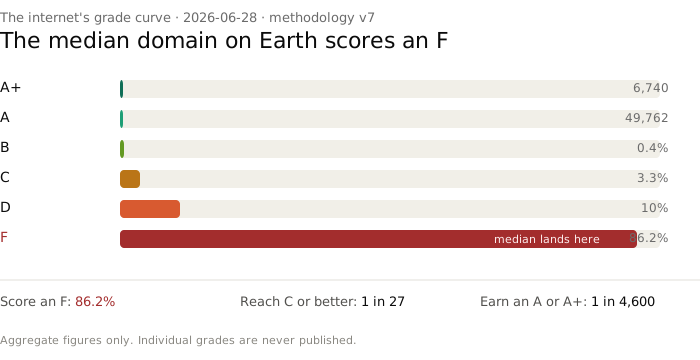
Read down that table and the shape is unmistakable: the curve is not a bell centered on “B.” It is a cliff. 78.3% of the internet scores an F, another 13.7% scores a D, and everything above a C is a rounding error by comparison.
How rare is a good grade?
Very. Across the whole census:
- Only 1.69% of domains earn a B or better — roughly 1 in 60.
- Only 0.15% earn an A or A+ — roughly 1 in 700.
- A C or better — the bar for “has meaningful protection at all” — is reached by fewer than 1 in 12 domains.
In other words, a domain that is genuinely well-configured is not the norm you are failing to meet. It is a rare exception. The good news hidden in that statistic: clearing the bar puts you ahead of the overwhelming majority of the internet, and most of the steps are free.
Why is the curve so skewed toward F?
Three reasons, and none of them are “the internet is full of hackers”:
- The defaults are off. When you register a domain, email authentication (SPF, DKIM, DMARC), DNSSEC, CAA and security headers are not enabled for you. Someone has to turn them on — and almost nobody does.
- Nobody tells the owner. A small business owner who buys a domain is never warned that, by default, criminals can send email that appears to come from their exact address. There is no error message for “your domain can be impersonated.”
- The protections are invisible until they fail. A missing SPF record causes no visible problem — right up until a fraudster uses your domain to invoice your customers, or your genuine email starts landing in spam.
The result is a grade curve that reflects neglect, not malice.
What an F actually means for a business
A failing grade is not an abstract score. In plain terms, an F usually means one or more of these is true of the domain:
- Its email can be forged. Without enforced SPF and DMARC, anyone can send email that looks exactly like it came from that domain — to its customers, staff and suppliers — and it lands in the inbox. This is the mechanism behind fake-invoice and CEO-fraud scams.
- Its genuine email is more likely to be junked. Gmail and Yahoo increasingly distrust unauthenticated domains, so real quotes and invoices quietly land in spam.
- It fails other companies’ security checks. Larger customers scan a supplier’s domain before signing. “Can be spoofed” is enough to lose the contract.
- Its website can warn visitors away. A missing or broken certificate shows shoppers a red “Not secure” page.
How does the grade curve change over time?
Because the scanning fleet re-measures the population continuously, this distribution is live, not a one-off snapshot. We publish it as a recurring report so the curve can be tracked edition over edition — if the internet gets more secure, this page will show it. Compare the moving league tables here:
Frequently asked questions
What is the average domain security grade in 2026? The most common grade across the 377 million domains we measured is F, and the typical (median) domain scores a D or below. Only 1.69% of domains earn a B or better.
What percentage of websites fail basic security? As of 2026-08-16, 78.3% of graded domains score an F — effectively unprotected and able to be spoofed — and a further 13.7% score a D.
How many domains have an A grade? Only 72,216 domains earn an A+ and 477,419 earn an A — together about 0.15% of all graded domains, or roughly 1 in 700.
Is a low grade just because a domain is parked or inactive? No. A domain scores poorly because it genuinely fails real, externally observable checks — for example, it can be spoofed because it has no enforced SPF and DMARC. Checks that genuinely cannot be determined are marked N/A and excluded; they never count as a failure.
See where your own domain sits on the curve
These are population averages. Your domain might be one of the 1.69% that earn a B or better — or one of the 78.3% that don’t. You can check it privately and free, and see exactly which of the 34 checks you pass and how to fix the ones you don’t.
Check your domain → · How we grade → · Aggregate data only; an individual domain’s grade is shown only to its verified owner. Data stored and processed in the EU.