Where a country's email lives: Microsoft, Google and the domestic hosts, by ccTLD
In the September 2026 census, 55,671,535 graded domains under 244 country-code TLDs (Top-Level Domains) publish an MX (Mail Exchange) record that names a usable mail host. Google receives the mail for 8.4% of them and Microsoft for 9.2%, 17.6% together. In August, an analysis of the Tranco top million, the most popular domains on the web, put the same two providers at 38.6%. Across whole country-code zones they hold less than half of that.
Most of the rest goes to hosting companies, registrars and telcos. In 14 of the 36 codes that aren’t sold worldwide, the biggest of them is controlled from the code’s own country. OVHcloud receives the mail for 33.9% of .fr mail domains, more than Google and Microsoft together. Tencent receives it for 31.2% of .cn and Yandex for 20.6% of .ru. Another 26.4% of ccTLD mail domains point their MX at a host under their own name, such as mail.example.de. That looks like a server of their own. For 87.1% of them, though, the address has a reverse DNS (Domain Name System) name under a different domain, and the largest groups of those belong to hosting companies.
A ccTLD isn’t a country. A .de name can belong to a company anywhere, a German company may use .com instead, and .io, .ai, .co and .me are sold worldwide as general-purpose endings. The figures describe the domains registered under each code. An MX record says who receives a domain’s mail first. It doesn’t say where the mailboxes are or where the messages are stored.
Who receives the mail under each code
The chart covers the 40 ccTLDs with the most mail domains, which together hold 91.2% of all ccTLD mail domains in the census. Each bar splits one ccTLD by where its domains’ primary MX record points, ordered from the highest combined share for Google and Microsoft to the lowest.
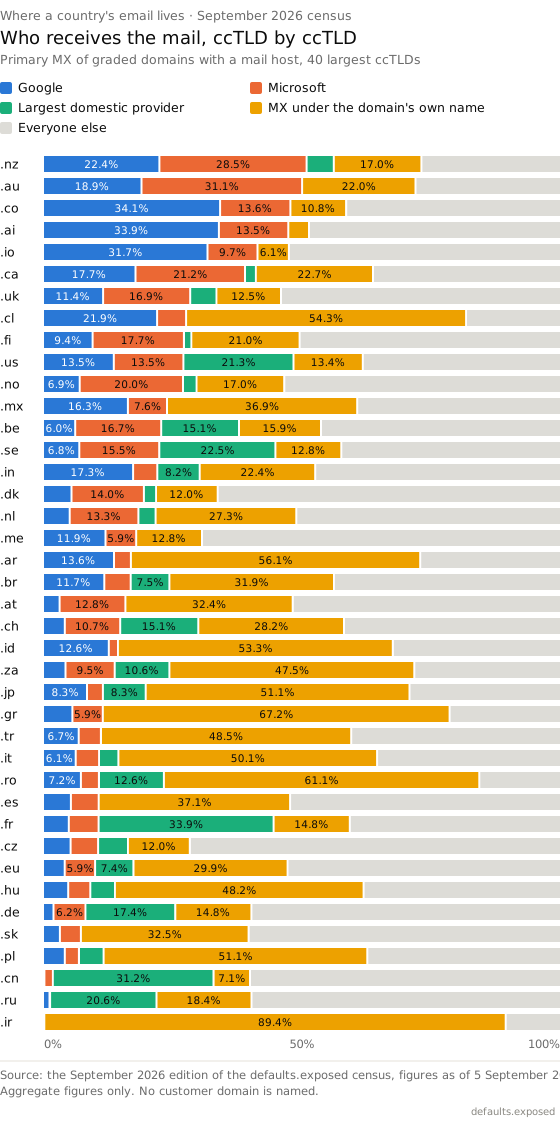
Figure 1. Where the primary MX record points, for the 40 largest ccTLDs. Shares are of each ccTLD’s graded domains with a usable MX record.
Microsoft is ahead of Google in 22 of the 40 and Google in 17, and in .us the two are level. Microsoft’s strongest codes are .au (31.1%), .nz (28.5%) and .ca (21.2%), and in .au and .nz it receives the mail for more domains than any other single provider. Google’s highest shares are in three of the codes sold worldwide, 34.1% of .co, 33.9% of .ai and 31.7% of .io, followed by .nz (22.4%) and .cl (21.9%).
Only in 6 of the 40 do the two together pass the 38.6% measured across the popular top million: .au, .ca, .co, .io, .ai and .nz. In .de they hold 8.0%, in .ru 1.2%, in .cn 1.7% and in .ir 0.05%.
The table gives the full figures. The domestic column names the largest provider controlled by a hosting group headquartered in the country the code belongs to, leaving out Google and Microsoft, and only when it holds at least 1% of the code’s mail domains. For .eu, any EU member state counts. In .es, .mx, .tr, .ir, .sk, .gr and .fi the cell says “not established”: in each of them, an MX host this study couldn’t identify, or a local brand whose owner it couldn’t confirm, holds at least as much as the largest confirmed one.
| # | ccTLD | place | mail domains | Microsoft | largest domestic provider | MX under own name | |
|---|---|---|---|---|---|---|---|
| 1 | .de | Germany | 8,862,637 | 1.8% | 6.2% | IONOS, 17.4% | 14.8% |
| 2 | .uk | United Kingdom | 4,543,573 | 11.4% | 16.9% | StackMail, 5.1% | 12.5% |
| 3 | .nl | Netherlands | 2,875,613 | 5.0% | 13.3% | Mijndomein, 3.3% | 27.3% |
| 4 | .ru | Russia | 2,821,754 | 1.1% | 0.1% | Yandex, 20.6% | 18.4% |
| 5 | .fr | France | 2,592,935 | 4.8% | 5.8% | OVHcloud, 33.9% | 14.8% |
| 6 | .br | Brazil | 2,393,623 | 11.7% | 5.1% | Locaweb, 7.5% | 31.9% |
| 7 | .it | Italy | 2,189,154 | 6.1% | 4.5% | Aruba, 3.8% | 50.1% |
| 8 | .au | Australia | 1,826,967 | 18.9% | 31.1% | none with 1% or more | 22.0% |
| 9 | .pl | Poland | 1,564,098 | 4.0% | 2.7% | LH.pl, 4.8% | 51.1% |
| 10 | .ca | Canada | 1,517,154 | 17.7% | 21.2% | Tucows (OpenSRS Hosted Email), 2.1% | 22.7% |
| 11 | .eu | European Union | 1,494,245 | 4.0% | 5.9% | IONOS, 7.4% | 29.9% |
| 12 | .ch | Switzerland | 1,334,819 | 4.0% | 10.7% | Hostpoint, 15.1% | 28.2% |
| 13 | .in | India | 1,252,853 | 17.3% | 4.7% | Zoho, 8.2% | 22.4% |
| 14 | .co | Colombia | 1,241,513 | 34.1% | 13.6% | sold worldwide | 10.8% |
| 15 | .jp | Japan | 1,173,711 | 8.3% | 3.1% | Lolipop (GMO Pepabo), 8.3% | 51.1% |
| 16 | .es | Spain | 970,893 | 5.2% | 5.4% | not established | 37.1% |
| 17 | .za | South Africa | 907,264 | 4.2% | 9.5% | Afrihost, 10.6% | 47.5% |
| 18 | .be | Belgium | 852,641 | 6.0% | 16.7% | Combell, 15.1% | 15.9% |
| 19 | .cz | Czechia | 826,477 | 5.1% | 5.3% | Seznam.cz, 5.8% | 12.0% |
| 20 | .se | Sweden | 784,936 | 6.8% | 15.5% | one.com, 22.5% | 12.8% |
| 21 | .at | Austria | 719,212 | 3.0% | 12.8% | none with 1% or more | 32.4% |
| 22 | .dk | Denmark | 670,553 | 5.3% | 14.0% | WebHosting.dk, 2.4% | 12.0% |
| 23 | .hu | Hungary | 557,472 | 4.7% | 4.3% | MediaCenter, 4.8% | 48.2% |
| 24 | .us | United States | 541,438 | 13.5% | 13.5% | GoDaddy, 21.3% | 13.4% |
| 25 | .mx | Mexico | 520,674 | 16.3% | 7.6% | not established | 36.9% |
| 26 | .io | British Indian Ocean Territory | 500,929 | 31.7% | 9.7% | sold worldwide | 6.1% |
| 27 | .ai | Anguilla | 445,049 | 33.9% | 13.5% | sold worldwide | 4.0% |
| 28 | .ro | Romania | 417,273 | 7.2% | 3.5% | ROMARG, 12.6% | 61.1% |
| 29 | .tr | Türkiye | 414,096 | 6.7% | 4.3% | not established | 48.5% |
| 30 | .ir | Iran | 401,416 | 0.02% | 0.03% | not established | 89.4% |
| 31 | .cn | China | 389,449 | 0.07% | 1.6% | Tencent, 31.2% | 7.1% |
| 32 | .me | Montenegro | 383,042 | 11.9% | 5.9% | sold worldwide | 12.8% |
| 33 | .id | Indonesia | 382,403 | 12.6% | 1.8% | none with 1% or more | 53.3% |
| 34 | .cl | Chile | 379,323 | 21.9% | 5.6% | none with 1% or more | 54.3% |
| 35 | .no | Norway | 372,458 | 6.9% | 20.0% | Webhuset, 2.6% | 17.0% |
| 36 | .nz | New Zealand | 336,814 | 22.4% | 28.5% | 1st Domains, 5.3% | 17.0% |
| 37 | .sk | Slovakia | 336,151 | 3.1% | 4.1% | not established | 32.5% |
| 38 | .gr | Greece | 336,097 | 5.5% | 5.9% | not established | 67.2% |
| 39 | .ar | Argentina | 325,176 | 13.6% | 3.3% | none with 1% or more | 56.1% |
| 40 | .fi | Finland | 321,435 | 9.4% | 17.7% | not established | 21.0% |
Where a home provider is the largest
In 13 of the 36 codes that aren’t sold worldwide, the largest domestic provider receives the mail for more domains than Google and more than Microsoft. The second chart shows the twelve largest domestic shares, with Google and Microsoft marked on the same scale.
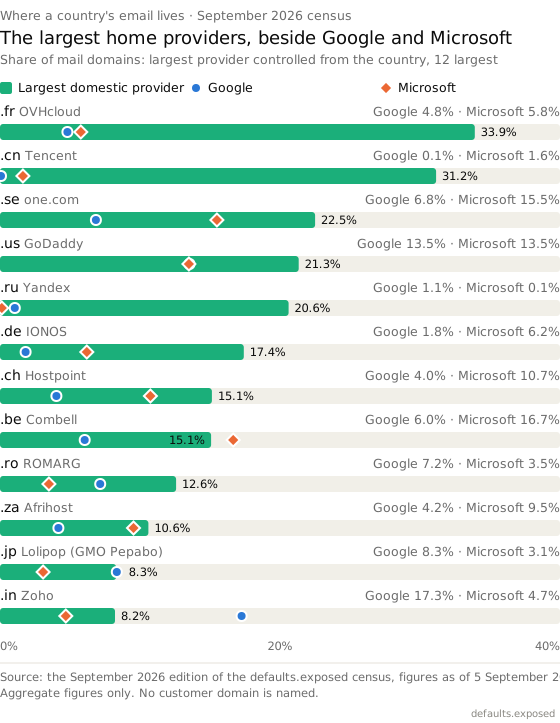
Figure 2. The largest provider based in the country, by share of the ccTLD’s mail domains, beside Google (circle) and Microsoft (diamond).
Among the 36 codes not sold worldwide, OVHcloud’s 33.9% of .fr is the largest share any single provider holds, Google and Microsoft included. In .cn, Tencent receives the mail for 31.2% and Microsoft for 1.6%. Alibaba Cloud and NetEase, also Chinese, hold 17.9% and 8.9%. In .ru, Yandex holds 20.6% and Google and Microsoft 1.2% between them.
In .de, IONOS receives the mail for 17.4% of mail domains and Strato for 15.8%. Both belong to United Internet, so together that group holds 33.2%, against 8.0% for Google and Microsoft. one.com is the largest provider in both .dk (23.6%) and .se (22.5%). Its group, group.one, has its legal seat in Malmö, so the table counts it as domestic in .se and not in .dk. GoDaddy leads .us with 21.3%, though under .us Google and Microsoft are domestic companies too.
In several codes the biggest brand run from the country belongs to a group based elsewhere. Domeneshop holds 19.7% of .no and has belonged to Miss Group, of Stockholm, since August 2024. WebSupport holds 15.2% of .sk, Loopia 12.6% of .se and Register.it 7.2% of .it, and all three are brands of team.blue, a group based in Belgium. WEDOS, with 12.1% of .cz, names a Luxembourg holding company as its headquarters, and 123 Reg, with 7.5% of .uk, has been GoDaddy’s since 2017.
In .au, where Microsoft is strongest, no provider controlled from Australia reaches 1% of mail domains under its own brand.
Own name on the MX, someone else’s address
26.4% of ccTLD mail domains point their primary MX at the domain itself or at a name under it. That is what a mail server run by the owner looks like from outside, and it’s the simplest way to count self-hosting from DNS. It’s far more common in some codes than others: 89.4% of .ir mail domains, 67.2% of .gr and 61.1% of .ro, against 4.0% of .ai.
The census also records the reverse DNS name of the primary MX host’s address. For 87.1% of own-name MX domains, that name sits under a different domain, and the most common ones belong to hosting companies. Only 2.5% have a reverse name under the domain itself.
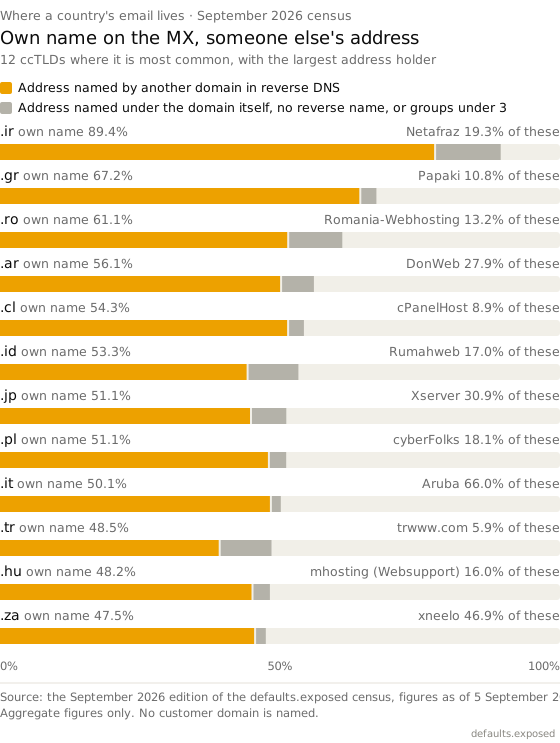
Figure 3. Own-name MX hosts, split by the reverse DNS name of their address. The note on each row names the company whose addresses hold the most of them.
In .it, 66.0% of own-name MX hosts are on addresses that reverse-resolve to Aruba, an Italian hosting company. That’s 33.1% of all .it mail domains receiving their mail at an Aruba address under an MX name of their own. In .za, 46.9% of own-name hosts are on xneelo’s addresses. In .jp, Xserver and Sakura Internet hold the two largest groups.
A reverse DNS name shows who holds the address. The mail software on it may be run by someone else, because a shared hosting server, a rented virtual machine and a company’s own machine in a data centre can all carry the hosting company’s name.
The popular-domain baseline
On 25 August 2026, the Internet Society’s Pulse blog published a guest analysis of the Tranco top million, using OpenINTEL’s DNS snapshot of 18 July 2026. Of about 659,000 popular domains with an MX record, it found 21.8% at Google and 16.8% at Microsoft, with self-hosting down to 22.4% from 44.6% in 2016.
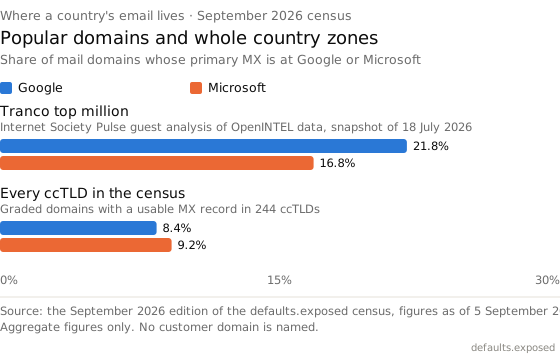
Figure 4. Google’s and Microsoft’s shares in two populations measured two ways. The Tranco figures are from the Internet Society Pulse analysis; the ccTLD figures are this census.
The two populations differ. The top million is the domains people visit most, and the study’s author notes that Tranco leans towards US and European domains. The census counts every graded domain under each ccTLD, popular or not. Both classify the primary MX record. They map providers with different lists, and the study’s self-hosting figure and this page’s own-name share are counted differently, so only the Google and Microsoft shares are set side by side.
How the figures were computed
All figures come from the September 2026 census, as of 5 September 2026. The population is every graded domain under a two-letter TLD, one row per domain. Internationalised country codes such as .рф are left out. Dead domains have no MX record captured, so the base is graded domains whose MX records name a usable host: records that name nothing (the RFC 7505 Null MX, MX 0 .), localhost or a host under .invalid are removed first, as on the MX record count page. That leaves 55,671,535 ccTLD mail domains, and every ccTLD’s count matches that page’s own extract to the domain. Every share on this page is of that base, ccTLD by ccTLD.
The primary MX is the usable record with the lowest preference value. Its host is reduced to its registrable domain and matched against a list of mail providers, which this study extended with domestic hosts for each country. Google means hosts under google.com and googlemail.com. Microsoft means the hosts under outlook.com and mx.microsoft that receive Microsoft 365’s mail, plus hotmail.com and Microsoft’s government and China clouds. A provider is a brand as it appears in the MX name, so a group that runs two brands counts twice. A provider is domestic when the hosting group that controls it is headquartered in the code’s country. Ownership is traced through hosting groups, never through financial owners such as investment funds, and checked against the companies’ own pages and the brand lists that team.blue, group.one, Miss Group and Your.Online publish. A local brand whose owner couldn’t be confirmed is never named as a domestic leader.
The reverse DNS check confirms the classification. 4,665,785 Google-classified domains have a reverse name for their primary MX address, and all but 1,326 of those names are under Google’s own domains. For Microsoft it’s all but 2,177 of 4,877,700. For the other named providers, 89.4% have a reverse name under one of the provider’s own domains. Every MX host domain holding at least 0.8% of one of the 40 codes was identified by hand or looked up, and in every code with a named domestic leader, no host left unidentified holds more than that leader.
Shares are rounded to one decimal place. Nothing here is compared with an earlier edition, and the what we compare page says why.
Check your own domain
The free scan reads a domain’s MX records live, along with the SPF (Sender Policy Framework), DKIM (DomainKeys Identified Mail) and DMARC (Domain-based Message Authentication, Reporting and Conformance) records that decide whether mail sent in its name is accepted. It works the same whichever provider receives the mail.
Figures as of 5 September 2026, from the September 2026 edition of the defaults.exposed census. The Internet Society Pulse analysis is dated 25 August 2026. Census numbers move every month; the current values are on the data page.